Professional Tools without the Premium Price Tag 🔥 In Stock UK – Free Next Day UK Mainland Delivery on Air Compressors →
UK stock • 1-year warranty • Free UK mainland delivery on all air compressors • UK-based support • Hassle-free returns
A sharp tool is a safe tool — and a pleasure to use. A blunt chisel requires more force, is harder to control, and produces a poor finish. A sharp one glides through wood cleanly with minimal effort. The bench grinder is the fastest and most effective way to restore a sharp edge to almost any tool. Here's how to do it properly.
Why Use a Bench Grinder for Sharpening?
Hand sharpening on waterstones is a valuable skill — but it's slow. For restoring a badly damaged or heavily blunted edge, a bench grinder removes material far faster than any hand method. Once the correct bevel is established on the grinder, finishing on a whetstone or strop takes just seconds.
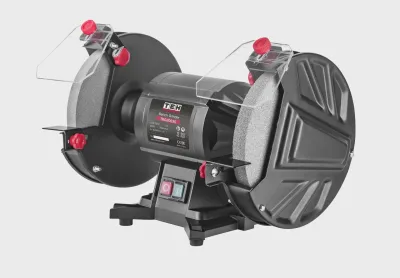
The TEH TBG20035 350W 200mm bench grinder is ideal for tool sharpening — with dual 200mm wheels, 2840 RPM, and a stable 12kg bench-mounted construction that stays firmly in place during use.
Before You Start — Wheel Dressing
Before sharpening anything, check the condition of your grinding wheel. Over time, grinding wheels become glazed (smooth and shiny) or loaded (clogged with metal particles). A glazed or loaded wheel grinds inefficiently and generates excessive heat.
Use a wheel dresser to restore the wheel surface:
Always dress the wheel before a sharpening session for best results.
The Golden Rule — Control the Heat
The biggest risk when grinding tools is overheating — also called drawing the temper. If a tool edge turns blue or straw-coloured during grinding, the steel has been overheated and the hardness has been destroyed. That section of the edge will never hold a sharp edge again.
How to prevent overheating:
Sharpening Chisels and Plane Blades
Chisels and plane blades are the most common tools sharpened on a bench grinder. The bevel angle is typically 25-30° for most woodworking chisels.
Step by step:
Common mistakes:
Sharpening Drill Bits
Sharpening twist drill bits on a bench grinder takes practice but is a valuable skill — a sharp drill bit cuts cleanly, requires less pressure, and produces less heat.
Step by step:
For beginners a drill bit sharpening jig makes this much easier — it holds the bit at the correct angle automatically.
Sharpening Garden Tools
Garden tools — spades, hoes, lawn edgers, and secateurs — benefit enormously from sharpening. A sharp spade cuts through soil and roots far more easily than a blunt one.
Step by step for spades and hoes:
For secateurs and pruning shears:
Sharpening Knives
A bench grinder can sharpen knives quickly — but requires care to avoid overheating thin blades.
What the Two Wheels Are For:
| Wheel | Grit | Use |
|---|---|---|
| Coarse wheel | Lower grit | Reshaping, heavy material removal, repairing damaged edges |
| Fine wheel | Higher grit | Finishing, final sharpening, refining the edge |
Always start on the coarse wheel for damaged or heavily blunted tools, then finish on the fine wheel. For lightly blunted tools that just need touching up, the fine wheel alone is often sufficient.
Safety — Non-Negotiable:
Browse the TEH TBG20035 200mm Bench Grinder and our full workshop tool range at tehtools.co.uk
Professional Tools without the Premium Price Tag 🔥 In Stock UK – Free Next Day UK Mainland Delivery on Air Compressors →
UK stock • 1-year warranty • Free UK mainland delivery on all air compressors • UK-based support • Hassle-free returns